Showing posts with label food. Show all posts

Saturday, January 4, 2014

DIY wild plant guidebook on your smartphone


I've been playing around with photo apps on my iPhone to save and categorize photos of wild plants. This helps me memorize the plants and also remember how to use them in the field. Recently I've been using an app called "Over" that lets you type information directly on the image itself. Here's an example:
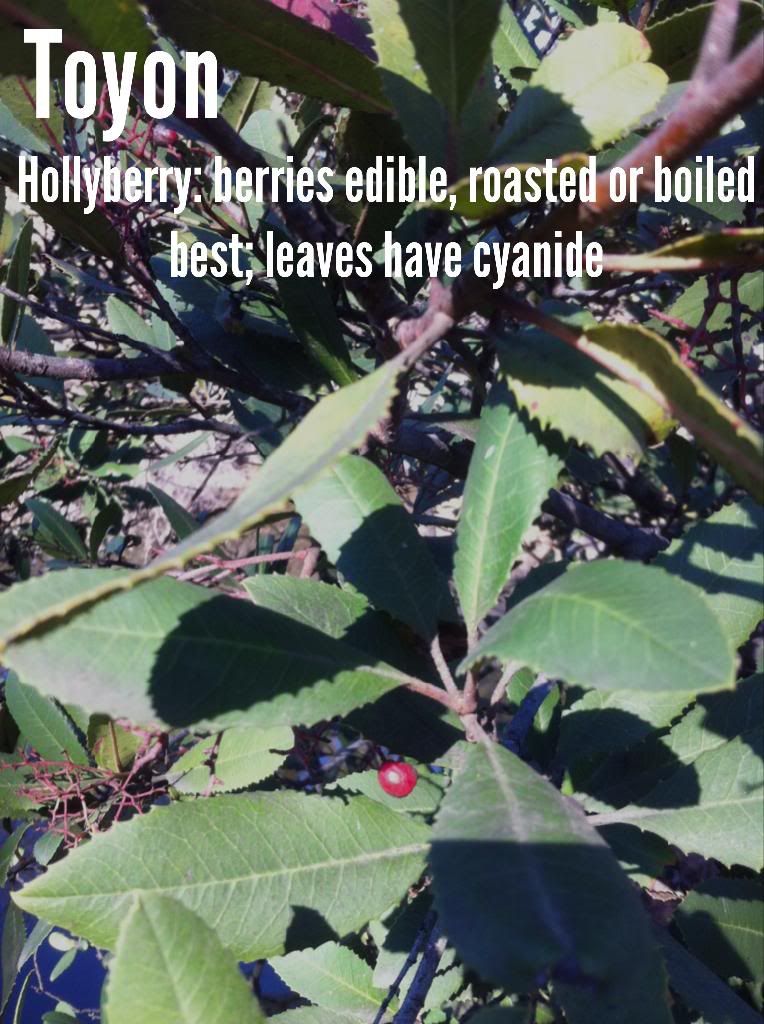

As you can see, I've typed in the plant name in large font. Then in smaller font I've listed that it goes by another name, "hollyberry," followed by common ways the plant can be used.

I shoot the photo in the field. Later I add in the useful info after consulting one or more guidebooks. This way, in the future, I won't have to tote various guidebooks in my pack, and I can include only info in the photo that's important to me.

The "Over" app costs $1.99, and it allows you to choose different fonts, sizes, move the fonts around, add graphics, and lots of other stuff. You can also change the font color, which may be helpful so the words stand out against the photo. There are similar free apps, and some are available for both iPhone and Android phones. For a review of several, click here.

I was never a big fan of bringing my phone along on hikes. But this kind of tool has made it worthwhile. Now I usually put the phone on "airplane mode" so nobody can bother me in the woods, and yet it's still with me in case of emergency.

I think these apps are worth a try to create a custom guidebook to your local plants and critters.

Tuesday, June 4, 2013

Coffee makes you crazy

I did something about a month ago that I never thought would enter my mind as a possibility. I gave up coffee. Pretty much cold turkey.

Now comes a determination by the American Psychiatric Association that caffeine withdrawal is an actual mental illness. It has been officially listed as such in their professional bible, the Diagnostic and Statistical Manual of Mental Disorders.

They don't mean withdrawal that results from giving something up. They mean the symptoms a caffeine addict experiences whenever the customary caffeine level in their system declines. Such as around noon, after the morning cuppa wears off. Or when you get home from work, when the afternoon pick 'em up cuppa is hours behind you.

If you drink more than two or three cups of coffee a day, you may experience withdrawal symptoms including headaches, grumpiness, trouble sleeping and difficulty focusing. Also:

People with this level of intoxication will show five or more of the following symptoms: restlessness, nervousness, excitement, insomnia, flushed face, diuresis, gastrointestinal disturbance, twitching, rambling thought or speech, tachycardia, arrhythmia, periods of inexhaustibly, or psychomotor agitation.
I gave up coffee after more than 25 years because I began to notice it was affecting my mood and my sleep. My addiction also affect my habits. For instance, on short dayhiking trips I would go to great lengths to bring along the necessary gear to be sure I could prepare a cup of hot joe on the trail. And I often had to mold my work schedule around that afternoon cup.

Frankly, I didn't think I could live without coffee. But the quitting process was surprisingly easy. There was only one hard day, about two or three days after I quit, when it felt like my system "crashed." I was in a kind of stupor, incapable of much activity or focused thought. But the very next day, I was fine.

I must note that I did not give up caffeine entirely, only coffee. I now drink mostly green tea, which has about a third as much caffeine.

This is all relevant because climate change may wipe out Arabica beans, which account for 70 percent of Earth's coffee production. So as I see it, the sooner we humans can wean ourselves of this addiction, the better off we'll be. I never thought I'd say that.

Sunday, October 30, 2011

Happy Halloween

Lots of press lately about the fact that Earth's human population is projected to reach 7 billion this week, as in this New Yorker piece by Elizabeth Kolbert. She notes that the projected day is tomorrow, Halloween. Yes, it's scary, so the timing seems appropriate.

More scary than the population number, however, is research mentioned by Kolbert that corn and soybean crop yields are projected to decline significantly by the end of this century. In other words, our food supply may not keep up with population growth, which is expected to continue rising: 8 billion in 2025, 10 billion in 2100, and still climbing.

I found the crop yield article, from Proceedings of the National Academy of Sciences in 2009. Kolbert picked the worst-case number from the study. But even under a less-bad climate change scenario, corn and soybean yields in the U.S. are projected to drop 30 percent.

I'm not going to fault Kolbert for picking the bigger number. Evidence is beginning to emerge that even the worst-case scenarios in the climate change models are starting to show signs that they are underestimating what's really going on (more on that at a future date).

The message -- however you slice the numbers -- is that we're about to drive the wheels off the family minivan. Somehow, we need to reconcile how we're growing as a species (population) and how we intend to feed that population.